
When we drove from Skopje to Pehchevo in 2025, we noticed an interesting rural village next to the road and we decided to visit there later that week. Once I saw the Church of St George in Budinarci, I remembered we had visited this village before in 2014 for the same reason: from the road it looked like a very authentic rural village worth a visit!

Just like in 2014 we found the Church of St George from 1854 closed, but this time we asked around and somebody went to get the woman who takes care of the church. The woman, named Vesela, opened the church for us with a huge key that operates an even larger lock on the door.


We also asked some locals and Vesala about the ruins of the Budinarci Fortress that should be near Budinarci. Nobody had a very clear answer, but Vesala got into the car with us and showed us some ruins on a hill about 1 km from Budinarci. The site is known under several names, Budinarci Kale, Gradishte and Budingrad.

There was not much to see. This is what Wikipedia has to say about the site:
“A mortared fortress wall was built in late antiquity in the 4th century and renovated in the 6th century. It encloses an area of 300×60 m, which consists of two parts – the upper and lower city. The upper city or the actual fortress is in the higher southern part. It has an area of 0.8 ha with a rectangular shape. At the southern end there is a small acropolis, separated by an inner wall and having a frontal tower. The lower city to the north also has an area of 0.8 ha and is separated from the upper one by a moat. At the northwestern end there is a tower, defending the easiest place to approach. Along the eastern wall, foundations of residential premises have been discovered, leaning against it. Ceramics, coins from the 4th, 5th and 6th centuries, bronze buckles and appliqués, iron fibulae from the end of the 6th and 7th centuries have been found in the fortress.
During the Middle Ages, a new one was built on the ancient wall with available materials without mortar, measuring 55×50 m, which is clearly visible on the terrain today. Fragments of medieval hearth ceramics, Slavic tiles, fragments of Slavic bronze jewelry, rings, buckles, pulleys, glass pulleys from the 11th–13th centuries have also been discovered”.

We only explored the south part closest to the asphalt road, since we did not want to keep Vesala waiting for our usual more thorough examination of such a site. See here for the location of the Budinarcio Fortress and make sure to have a look at the northern part as well when you visit. If there’s indeed more to see there, please let me know!
When we said goodbye to Vesela, she gave us some home-made bread, jam and cheese. Where else do you find such friendliness and hospitality than in Macedonia?
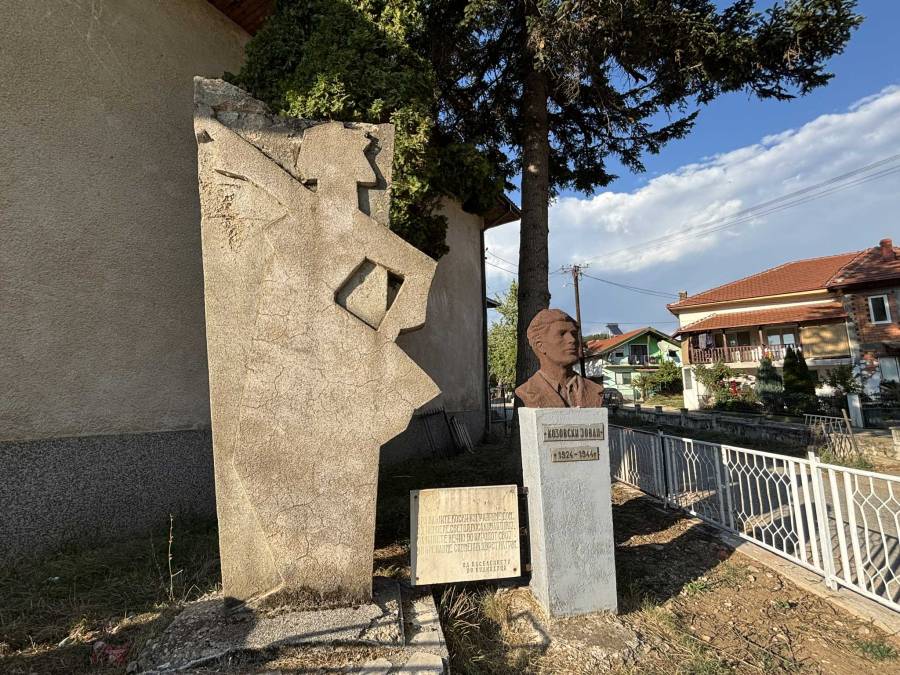
Below are some more pictures or rural Budinarci:



 My Macedonia Blog