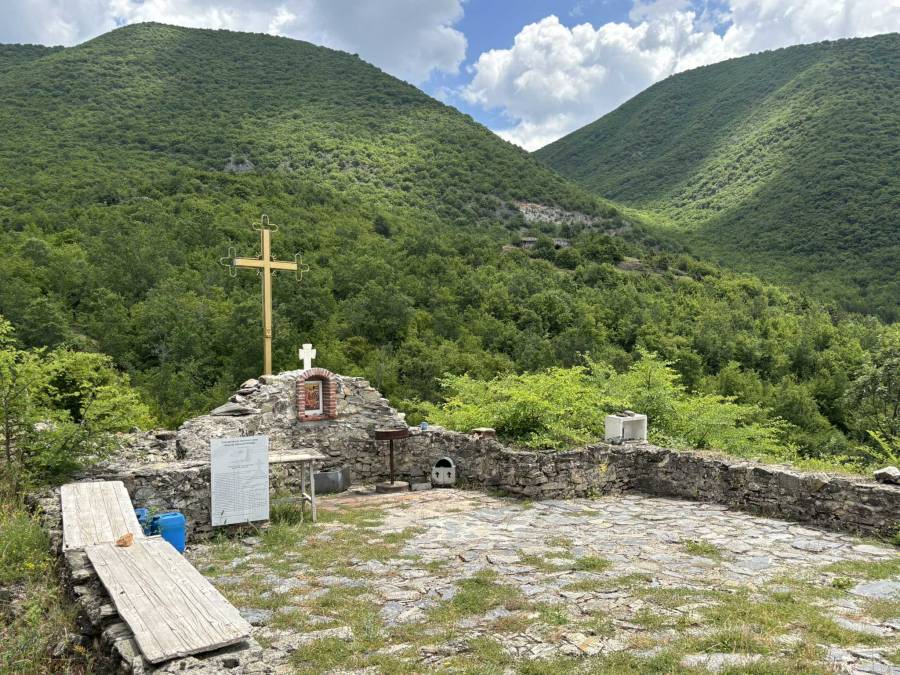
The ruins of the Monastery “Mala Bogorodica” or “Little Mother of God” are near the village Stenche. Stenche is about 20 km or a 30 min drive from Tetovo.
It is just a short walk of less than 500 m to the ruins, there is an asphalt road to the start of the walk. We parked the car at the start of the dirtroad.
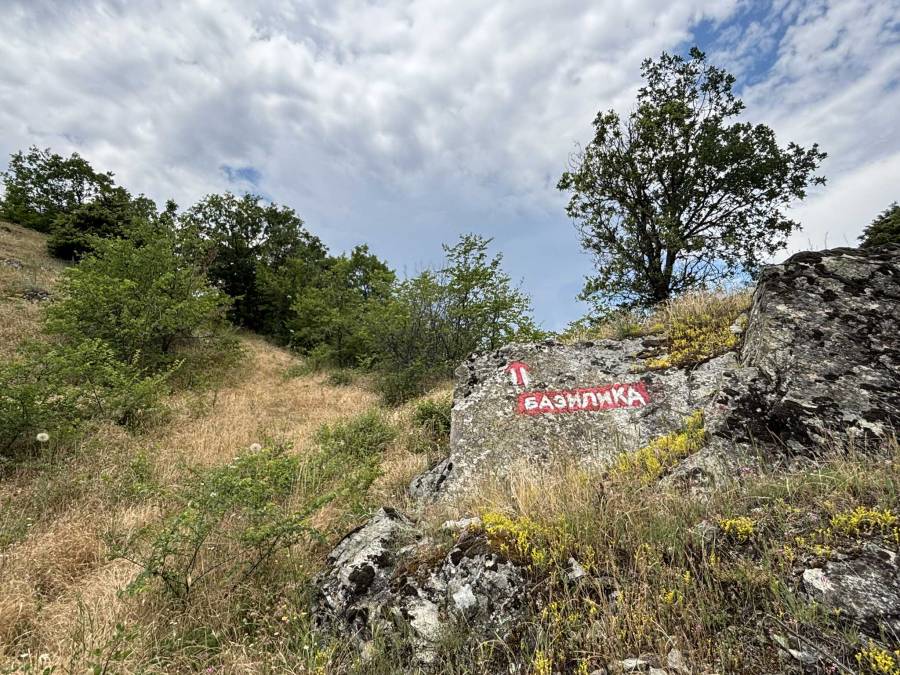
The path to the church is indicated with red/white paint saying “Basilica”.
A sign at the site says (translated by ChatGTP):
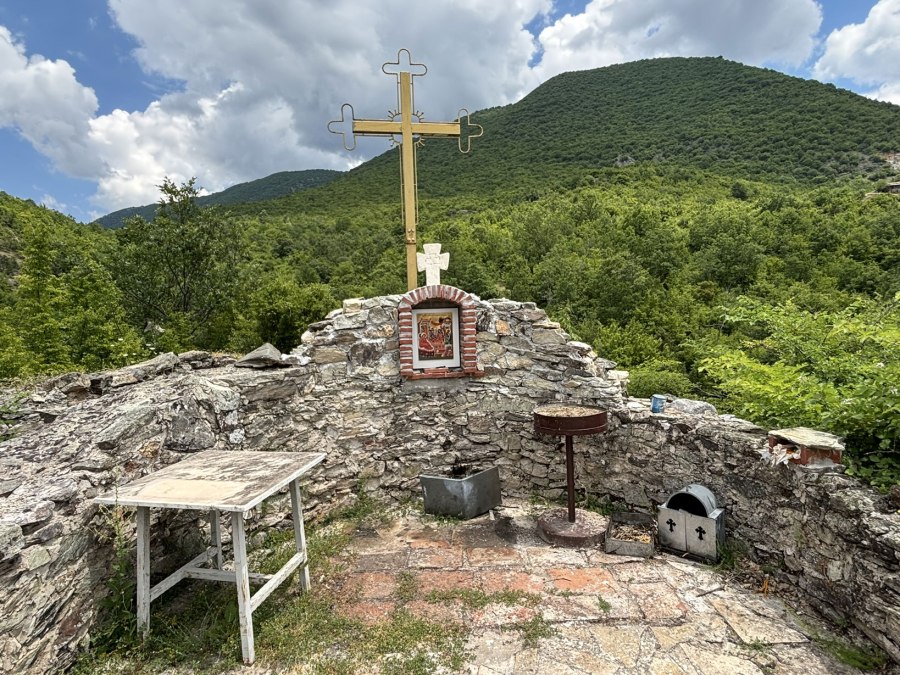
Early Christian Episcopal Center Monastery “Mala Bogorodica” (Little Mother of God)
You are standing at the oldest Early Christian episcopal center, Stenche, dating from the 5th century AD.
You are at the locality Gradište, where a large Early Christian basilica of approximately 230 m², dedicated to the Nativity of the Most Holy Theotokos (Mother of God), once stood.
This basilica was built in the 5th century and remained in use until the 15th century, for nearly 1,000 years. It was constructed during the time of the emperors Theodosius and Justinian, when Christianity was established by decree as the state religion.
Justinian was born in Taor, near Zelenikovo (Skopje), and ruled the second-largest empire after that of Alexander the Great. He built today’s Church of Hagia Sophia (Holy Wisdom) in Constantinople and established the third great Orthodox Church, the Archbishopric of Justiniana Prima.
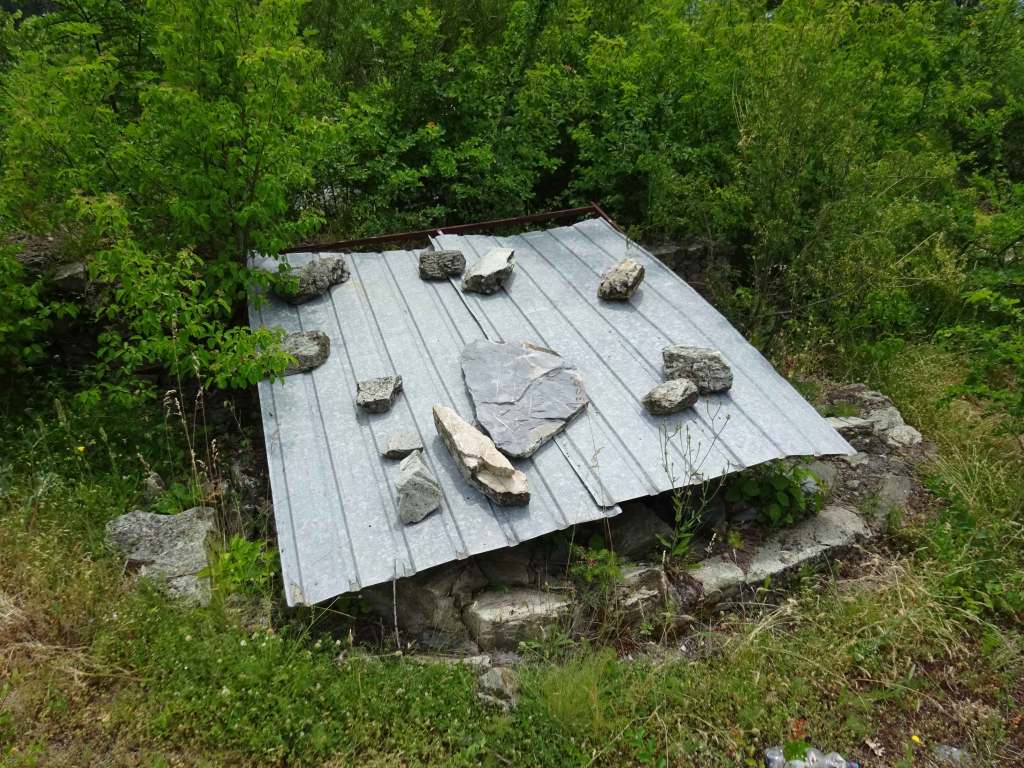
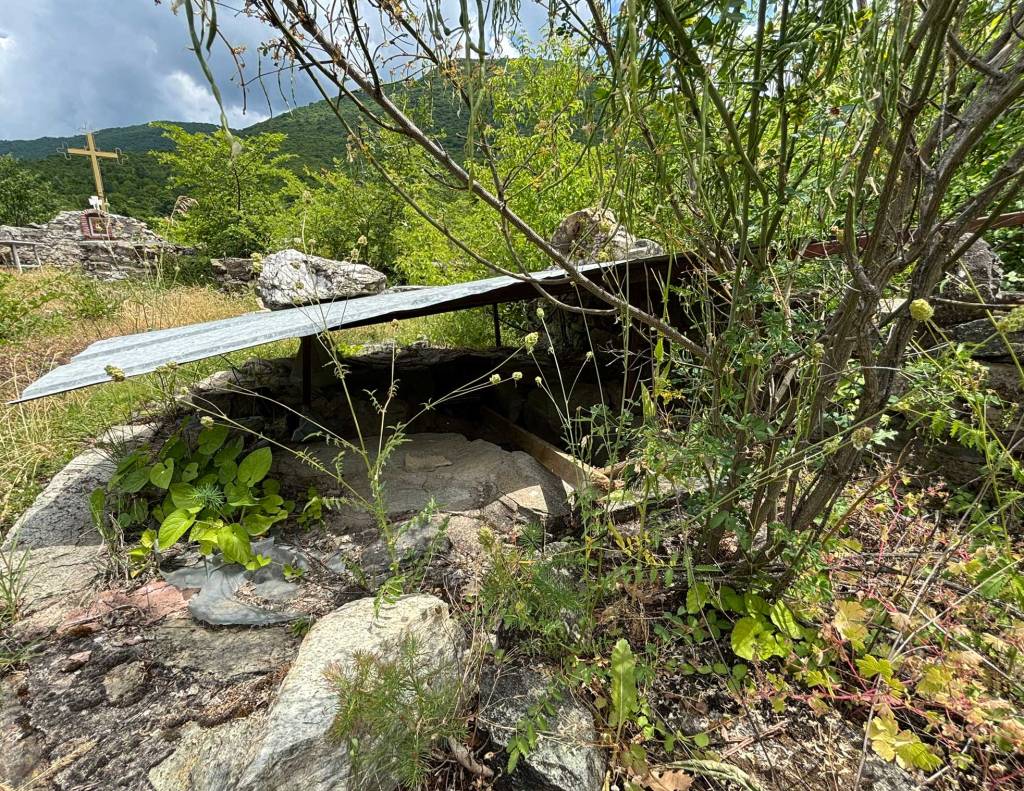
Within this basilica there are three Early Christian baptismal fonts from the 5th century, where the first baptisms of the Macedonian people in this part of Polog were performed by the local bishop.
According to archaeological discoveries, this monastery was surrounded by high walls in the shape of a ship and protected by towers on the south, west, and eastern sides.
According to research, the monastery was very wealthy and was plundered and destroyed five times during the Crusades.
According to local tradition, the Turks were unable to conquer the monastery for a long time. They eventually captured an old woman outside the walls and threatened to burn her alive unless she revealed the secret entrance. She told them that every morning, when the first ray of sunlight struck the monastery walls from Suva Gora, the hidden entrance would become visible. The Turks waited, found the entrance, entered the monastery, and burned it down.
According to archaeological finds and several reported visions in recent years, this church once possessed: a carved marble iconostasis, gilded icons, floors paved with ceramic tiles and stained-glass windows.
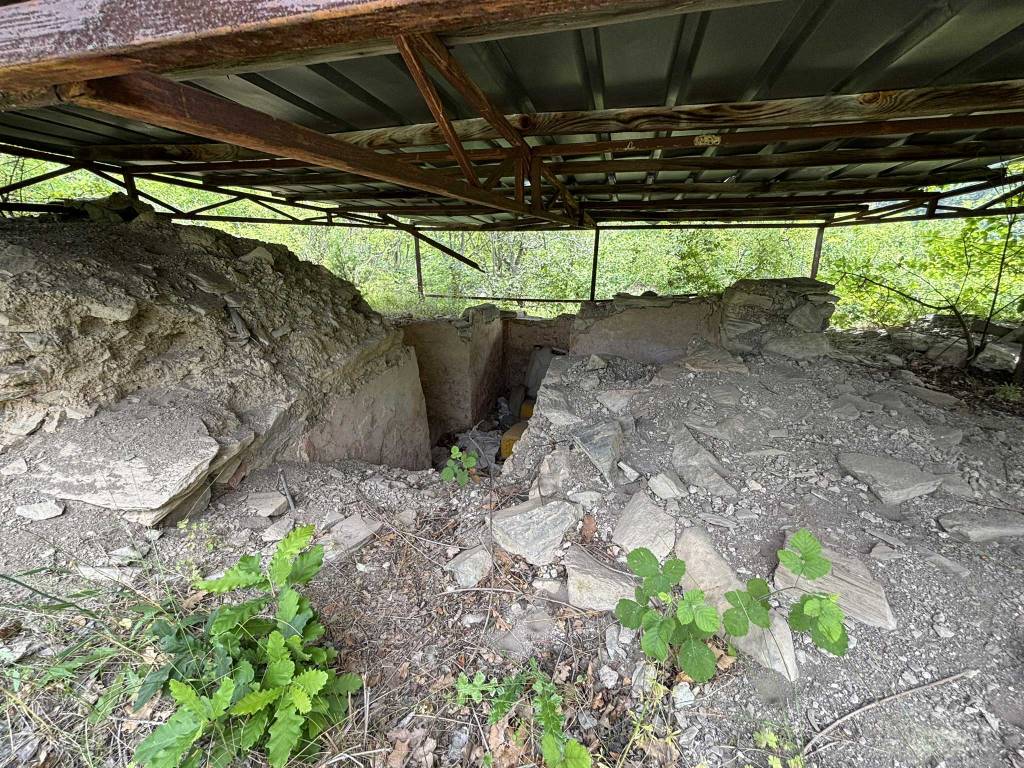
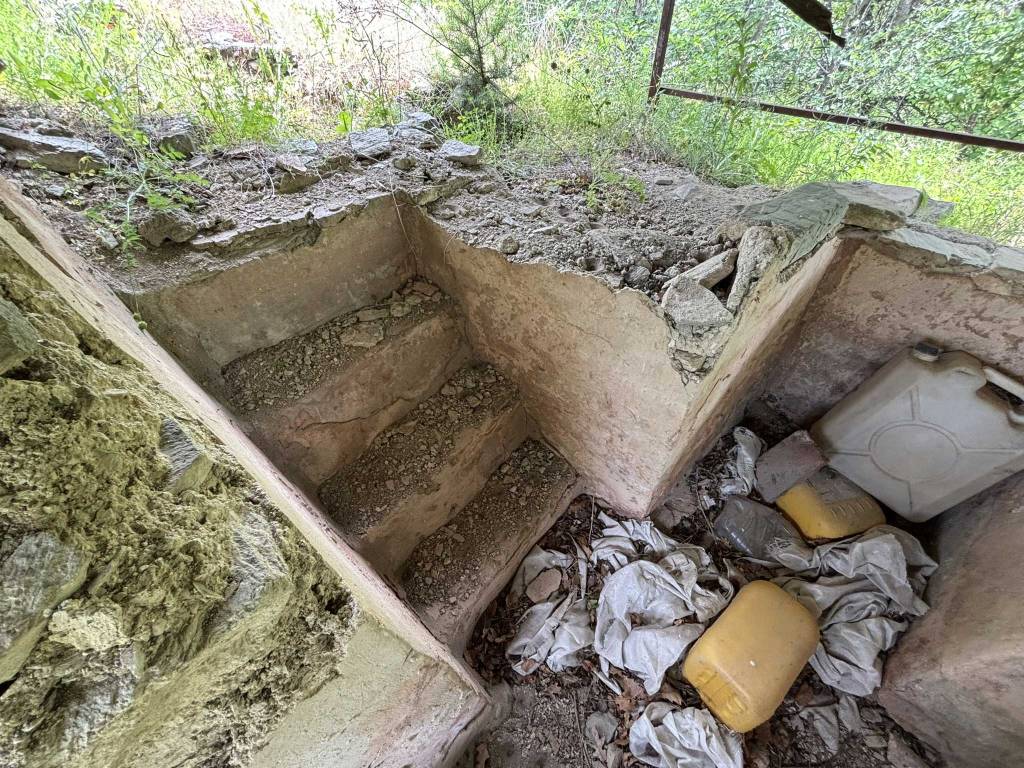
This monastery is visited by believers from all over the world, who come to pray and seek healing. According to tradition and reported visions, anyone who helps restore this monastery will have their prayers and wishes heard. Therefore, if you have a wish, kneel and pray to God, and light a candle below the icon on the piece of marble.
We invite you to attend the feast of the Nativity of the Most Holy Theotokos, on 21 September, when possible. On that day there is a blessing of the water (vodosvet) and the breaking of the ceremonial festive breads (kumski pogači).
Thank you for your visit.May the Lord and the Most Holy Mother of God hear and fulfill your prayers and wishes. With respect, The Church Committee of the village of Stenche
In addition, ChatGTP added these notes:
The sign mixes well-established archaeological facts with religious tradition and local legend:
- The existence of an Early Christian episcopal complex at Stenche and a 5th-century basilica is supported by archaeological research.
- The site contains important Early Christian baptisteries, although the statement that these were the “first baptisms of the Macedonian people” is a devotional interpretation rather than an established historical fact.
- Justinian I was indeed born near present-day Skopje (traditionally Taor) and founded Justiniana Prima, but he did not build the original Hagia Sophia. The first Hagia Sophia existed earlier; Justinian rebuilt it after the Nika riots in 532, creating the monumental church that still stands today.
- The stories about the monastery being destroyed five times during the Crusades, the old woman revealing the secret entrance, and the recent visions are local traditions rather than conclusions supported by archaeology.
It’s a fascinating sign because it combines archaeological information with local folklore and religious belief.
The sign mentions 3 baptisteries, of which one is destroyed. Indeed, 2 baptisteries are still visible on the side. Finding three baptisteries at one episcopal center is rather unusual. Most Early Christian cathedral complexes have one baptistery. Multiple baptisteries usually indicate: several construction phases over centuries, rebuilding after destruction, or different liturgical functions. That makes Stenche one of the more interesting Early Christian sites in North Macedonia.
St Ilija
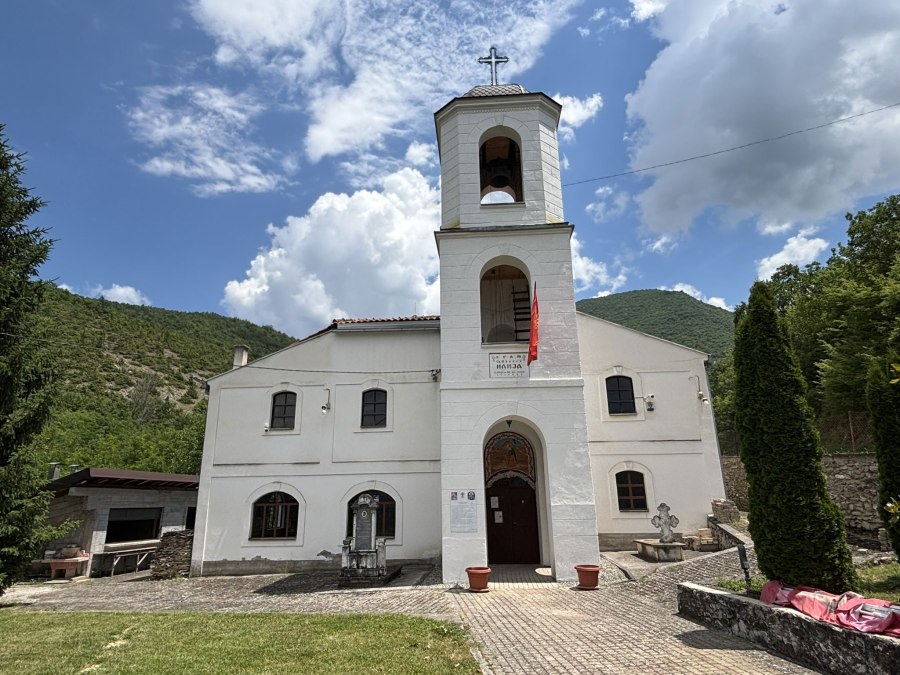
The Church of St Ilija (Eliah) is located a bit earlier on the road to the ruins of the St Mala Bogorodica Monastery. It was on our list of churches we wanted to visit, but it was closed. The sign at the entrance gives a little bit of history of the church (translated with ChatGTP):
According to archaeological findings, this church stands on the site of a much older sanctuary dating back to ancient times. During excavations for the church foundations, remains of earlier structures and burials were discovered. The excavations suggest that beneath the present church there are even older cultural layers, indicating that this place has been regarded as sacred for thousands of years, even before the arrival of Christianity.
Later, this sanctuary continued under the name of the Holy Prophet Elijah, which it bears to this day.
The church is mentioned in the charter of Emperor Stefan Dušan from 1345, which describes the boundaries of the monastery estates in this region, extending from the village of Sedlarevo, above Chelopek, across the Polog plain toward Gostivar and beyond.
The great antiquity of the sanctuary is also supported by the discovery of an ancient ceramic vessel, estimated to be around 5,000 years old, together with other archaeological finds.
The present church building dates from 1867. At that time the church was constructed and decorated with frescoes, an iconostasis, woodcarving, and interior paneling. The work was carried out by Dimo Zograf and his son Avram, together with craftsmen from the village of Tresonče, famous for its icon painters and woodcarvers.
We invite you every year to attend the feast of St. Elijah (Ilinden), when a traditional celebration is held. The festivities include:
- a cultural and artistic program,
- a review of traditional Upper Polog folk costumes,
- performances by cultural associations,
- and the traditional Upper Polog wedding ceremony, where the bride and groom wear authentic regional costumes.
If you would like to celebrate a wedding in this traditional manner, please contact the church committee. Thank you for your visit.
ChatGTP adds to this:
One interesting point is that the board makes several historical claims—such as a 5,000-year-old ceramic vessel and continuous sacred use since prehistoric times. Those claims appear to be based on local tradition and local archaeological interpretations. The 1867 construction date and the attribution of the decoration to craftsmen from Tresonče are much more consistent with the known history of churches in the Polog region.

